
Description
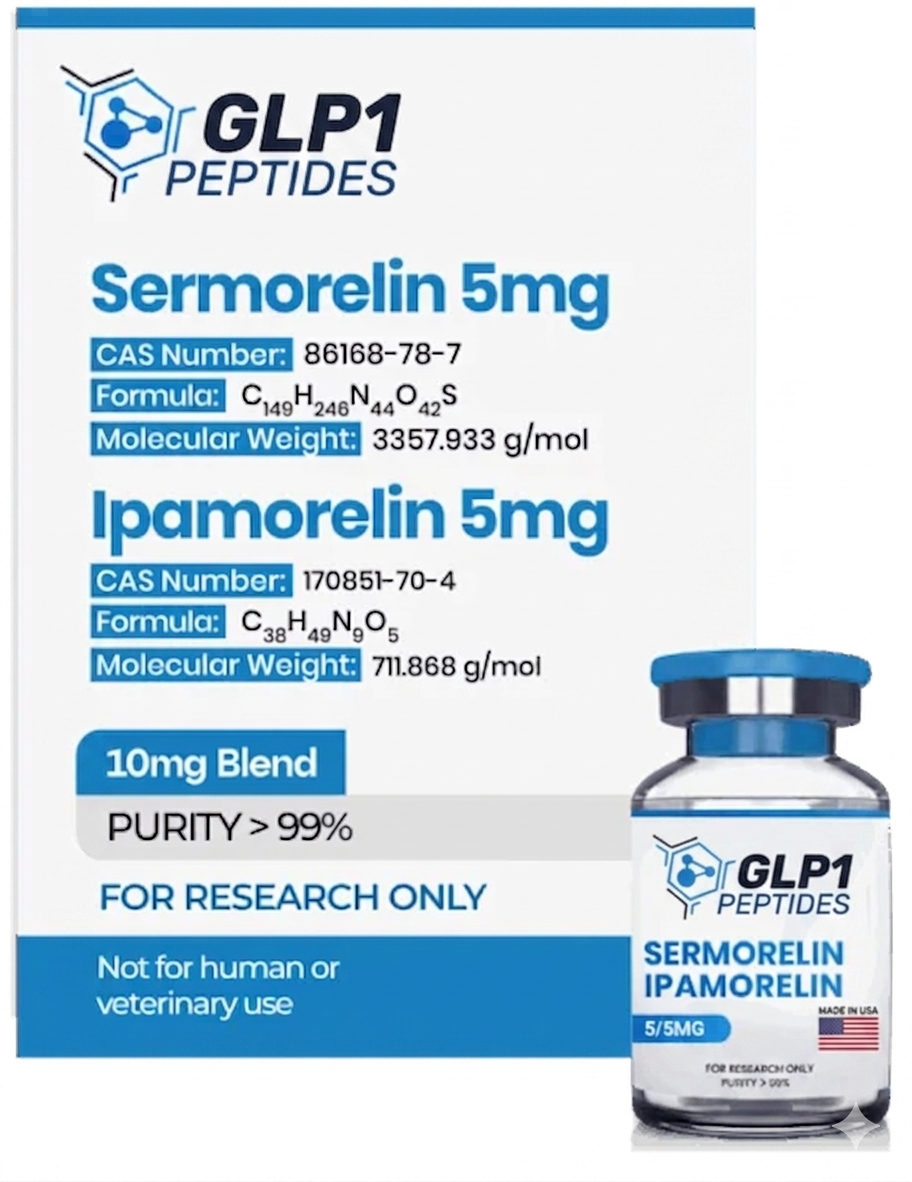
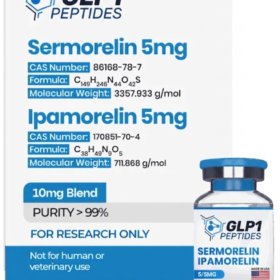
Sermorelin Specifications
Molecular Formula: C149H246N44O42S
Molecular Weight: 3357.9 g/mol
Sequence: Tyr-Ala-Asp-Ala-lle-Phe-DL-Thr-Asn-Ser-Tyr-Arg-Lys-Val-Leu-Gly-Gln-Leu-Ser-Ala-Arg-Lys-Leu-Leu-Gln-Asp-Ile-Met-Ser-Arg-NH2
Ipamorelin Specifications
Molecular Formula: C38H49N9O5
Molecular Weight: 711.86 g/mol
Sequence: Aib-His-D-2-Nal-D-Phe-Lys-NH2
Sermorelin & Ipamorelin Peptide Blend Research
Sermorelin & Ipamorelin Blend and GHRH Receptors
Combinatorial research concerning Sermorelin & Ipamorelin peptides posits that there may be a synergistic potential to induce maximal release of endogenous growth hormone when different pituitary receptors are activated simultaneously. Sermorelin is a growth hormone-releasing hormone (GHRH) analog. This peptide is purported to be the shortest sequence that might activate the GHRH receptors. Sermorelin’s approximate half-life is thought to be between 11 and 12 minutes. Test models have suggested relatively rapid turnover.[1, 2] This peptide is composed of the initial 29 amino acids out of the usual 44 amino acids present in GHRH.
Despite Sermorelin’s truncated amino acid structure, it is hypothesized that Sermorelin might interact with GHRH receptors. This may trigger periodic growth hormone emissions.[3] It is theorized that Sermorelin might initiate various intracellular signaling events upon engaging with these receptors. One proposed pathway is the adenylyl cyclase pathway, which may facilitate the conversion of ATP (adenosine triphosphate) to cAMP (cyclic adenosine monophosphate).[4] An increase in cAMP levels may activate protein kinase A (PKA), which might, in turn, phosphorylate several proteins, such as the voltage-dependent calcium channels in the cell membrane.
It is speculated that the phosphorylation and possible subsequent opening of these calcium channels may allow calcium ions to enter the somatotroph cells. The resultant rise in intracellular calcium levels is thought to be critical for the subsequent steps in growth hormone release. Researchers further hypothesize that elevated calcium levels inside the cell might stimulate the secretory vesicles within the somatotroph cells, which may potentially lead to the release of growth hormone into the bloodstream. The increase in growth hormone production is believed to potentially enhance levels of insulin-like growth factor-1 (IGF-1), which is considered to be involved in the anabolic actions of growth hormone.
Sermorelin & Ipamorelin Blend and GHS-R1a Receptors
Ipamorelin is thought to be the most specific and targeted analog of ghrelin/growth hormone secretagogue receptors, according to recent studies.[5] Researchers posit that the peptide is the first ghrelin mimetic “with a selectivity for GH release similar to that displayed by GHRH. The specificity of Ipamorelin makes this compound a very interesting candidate for future … development.” It appears to be a selective peptide agonist of the ghrelin hormone.
Ipamorelin’s primary speculated action is thought to be the increase of circulating levels of growth hormone without affecting other hormones regulated by the pituitary gland. Hormones stimulated by the pituitary gland may include prolactin, thyroid-stimulating hormone (TSH), adrenocorticotropic hormone (ACTH), luteinizing hormone (LH), follicle-stimulating hormone (FSH), or cortisol. This hypothetical mechanism distinguishes Ipamorelin from other ghrelin mimetics.
Ghrelin, referred to by researchers as the hunger hormone, is believed to regulate the release of growth hormone by activating the Growth Hormone Secretagogue Receptor type 1a (GHS-R1a) in pituitary cells. Ipamorelin is classified as a GHS-R1a agonist, which is considered the primary receptor for the endogenous hormone ghrelin.[3] In vitro experiments suggest that Ipamorelin’s interaction with GHS-R1a may influence somatotroph cells located in the anterior pituitary gland.[6] This interaction is hypothesized to trigger a cascade of intracellular signaling mechanisms.
One crucial component of this hypothetical signaling pathway is phospholipase C (PLC). This enzyme is thought to facilitate the production of secondary messenger molecules, including inositol triphosphate (IP3) and diacylglycerol (DAG). The production of IP3 is hypothesized to stimulate the release of calcium ions (Ca2+) from intracellular stores.
Simultaneously, DAG is believed to activate protein kinase C (PKC), a family of enzymes implicated in various cellular functions. This hypothetical increase in intracellular calcium ion concentration, along with the activation of PKC, is thought to lead to the exocytosis of vesicles containing growth hormones.
Reviews
There are no reviews yet.